
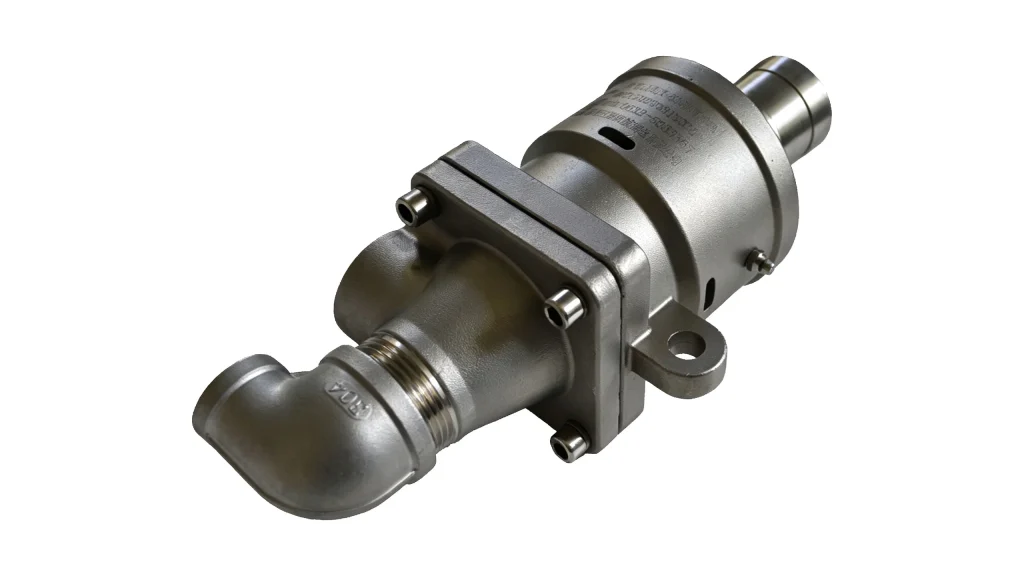
JF type mechanical seal rotary joint
JF type mechanical seal rotary joint, JF type mechanical seal rotary joints, JF type mechanical seal rotary union, JF type mechanical seal rotary unions, JF type mechanical seal swivel union, JF type mechanical seal swivel unions, JF type mechanical seal swivel joint, JF type mechanical seal swivel joints
The JF type mechanical seal rotary joint adopts an end face (flat) mechanical seal structure, which is a single path sealing connection device specially designed for stable transmission of media such as water, steam, and thermal oil in rotating equipment. The core feature is spring compensation+graphite/hard alloy friction pair, suitable for medium and high-speed working conditions
PRODCUT FEATUREA
1. H-type balanced mechanical seal structure, imported high-speed bearing double support, reliable structure, stable operation.
2. The main seal of the mechanical seal rotary joint is CNC precision machined to ensure surface roughness and flatness.
3. The wear amount of the sealing friction pair end face is extremely low under normal working conditions, and can be used continuously for 2 years, with a lifespan of 5-10 years in special occasions.
4. It has good vibration resistance, with an amplitude of no more than 0.05mm at a speed of 3000r/min, and the PV value can be continuously increased with use.
5. The power loss is small, and the friction pair of the mechanical seal is in a semi liquid friction state, with a very low friction coefficient μ.
6. The insensitivity of the rotating shaft to vibration and the deflection of the hollow shaft to the shell makes the bellows sealing shaft or shaft sleeve less susceptible to wear.
7. Mechanical seal rotary joints can ensure the reliability of sealing under extremely harsh working conditions with flammable, explosive, toxic and harmful media in circulation.
8. It has a wide range of applicable working conditions, with good performance in high temperature, low temperature, high pressure, vacuum dry friction, and high-speed working conditions of corrosive media.
9. Fluid design scheme allows for direct replacement of sealing components on the production line, facilitating maintenance and repair.
10. Rust proof slag isolates sediment and is suitable for working environments with solids and particles in the circulating medium.
11. Linear velocity: ≤ 15m/s, axial displacement: ± 1.0mm.
1、 Design requirements
(1) Sealing performance
End face seal: The key to JF type mechanical seal rotary joints lies in the design of the end face seal. Select high-performance sealing materials such as silicon carbide, carbon graphite, etc. to ensure that the sealing surface can be tightly adhered under different working conditions, effectively preventing medium leakage. The flatness and roughness of the sealing surface need to be strictly controlled, with flatness errors controlled at the micrometer level and roughness reaching Ra0.1-0.4 μ m to reduce friction and improve sealing effectiveness.
Auxiliary sealing: In addition to end face sealing, auxiliary sealing is also crucial. Use oil resistant, temperature resistant, and aging resistant rubber or polytetrafluoroethylene materials to make auxiliary seals such as O-rings and V-rings. During installation, ensure that the compression of the seals is moderate, which can ensure good sealing performance and prevent premature damage to the seals due to excessive compression.
(2) Material selection
Main material: The main body of the cooling water rotary joint is usually made of high-quality metal materials, such as stainless steel, copper alloy, etc. Stainless steel has good corrosion resistance and is suitable for working conditions where corrosive media are transported; Copper alloys have high strength and wear resistance, and can work stably under high-speed and high-pressure conditions.
Bearing material: Bearings are important components of rotary joints that need to withstand axial and radial loads. Choose high-precision and high load-bearing bearings, such as deep groove ball bearings, angular contact ball bearings, etc. The bearing material is generally bearing steel, which undergoes special heat treatment to improve its hardness and wear resistance, ensuring the smooth operation of the rotary joint.
(3) Structural Design
Reasonable channel design: Design a reasonable channel structure based on the flow rate and pressure requirements of the medium. The flow channel should ensure smooth medium flow, reduce resistance loss, and avoid medium retention and local overheating. At the same time, the size and shape of the flow channel should match the sealing structure to ensure that the sealing performance is not affected.
Easy to install and maintain: The structural design of rotary joints should consider the convenience of installation and maintenance. Adopting a modular design concept, each component is designed as a module that is easy to disassemble and assemble, making it convenient to quickly replace seals and other vulnerable parts during equipment maintenance. In addition, necessary installation positioning devices and maintenance interfaces should be set up to improve installation accuracy and maintenance efficiency.
JF type mechanical seal rotary joint
2、 Application industry
(1) Paper industry
In the dryer equipment of paper machines, JF type mechanical seal rotary joints are used to introduce steam into the dryer and discharge condensed water. Due to the high temperature and pressure inside the dryer during the papermaking process, as well as the corrosiveness of steam and condensate, the JF type mechanical seal rotary joint ensures a stable supply of steam and timely discharge of condensate with its excellent sealing performance and corrosion resistance, ensuring the drying quality and production efficiency of the paper.
(2) Chemical industry
In chemical production, various corrosive media transportation and reaction processes are often involved. The JF type mechanical seal rotary joint can be applied to the rotating connection parts of equipment such as reaction vessels and distillation towers to prevent the leakage of corrosive media and ensure the safety and stability of the production process. For example, in equipment producing highly corrosive chemicals such as hydrochloric acid and sulfuric acid, the sealing performance of rotary joints and the selection of corrosion-resistant materials are crucial. JF type mechanical seal rotary joints can meet these demanding working conditions.
(3) Steel industry
In the steel rolling equipment of steel production, JF type mechanical seal rotary joints are used to deliver cooling medium to the rolling mill rolls. During the steel rolling process, the rolling rolls are subjected to enormous pressure and friction, generating a large amount of heat that needs to be cooled in a timely manner. The JF type mechanical seal rotary joint can work stably in harsh environments with high temperature, high pressure, and high dust, ensuring reliable supply of cooling medium, extending the service life of rolling rolls, and improving the rolling quality of steel.