
high speed rotary joint
high speed rotary joint, high speed rotary joints
A high speed rotary joint is a precision sealing device that transfers fluid or air from a stationary supply line into rotating machinery without leakage. Anyone specifying rotating equipment eventually faces the same problem: a high speed rotary joint must hold a dynamic seal while the machine spindle turns at thousands of RPM, which places unique demands on balance, bearing stiffness, and face materials. This guide explains what a high speed rotary joint is, how it works, and how to choose, install, and maintain one, so your rotating system runs cool, clean, and reliable.
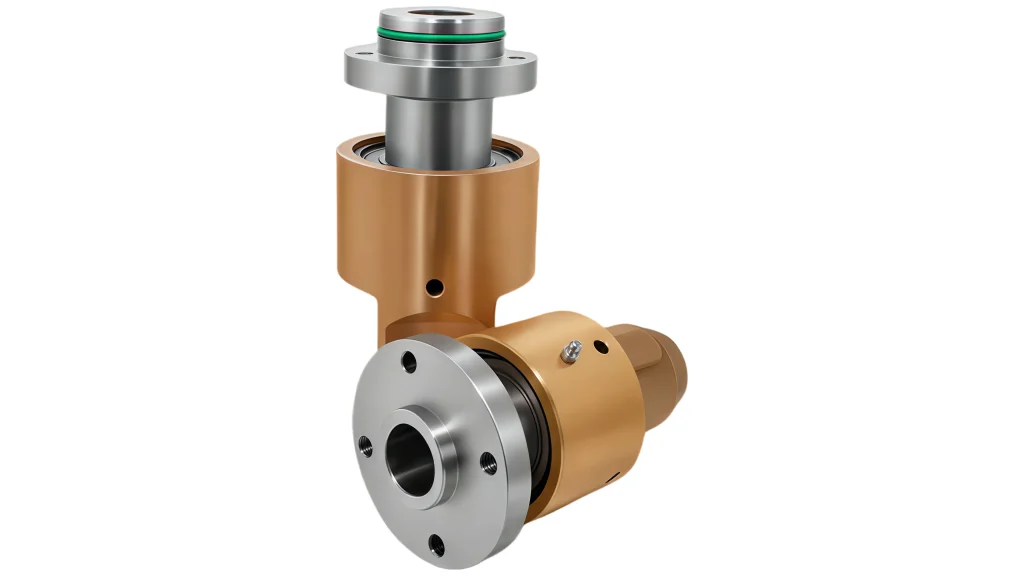
What Is a High Speed Rotary Joint?
The high speed rotary joint—also called a rotary union or swivel—is designed for continuous rotation well beyond the range of ordinary couplings. Where a standard joint may be rated for a few hundred RPM, it is engineered, precision-balanced, and bearing-supported to run at 1,000 to 30,000 RPM or more depending on size and media. The defining feature is not simply the speed number but the combination of speed with pressure, temperature, and media compatibility held simultaneously inside one compact housing.
How a High Speed Rotary Joint Works
Inside every such joint, a rotating shaft and a stationary housing meet at a pair of lapped seal faces. Fluid enters the stationary body, flows through the sealed interface, and exits along the rotating shaft channel into the machine. A spring stack keeps the faces lightly loaded together, while a film of the transferred medium itself lubricates the running gap between the faces. Because the faces ride on this micro-thin film, a well-designed rotary union achieves near-zero leakage while generating very little friction heat at speed. Balanced internal geometry also offsets hydraulic pressure forces, so face loading stays constant whether the joint runs at low or high pressure.
Key Components of a High Speed Rotary Joint
Understanding the internals makes troubleshooting much easier. A typical high speed rotary joint contains:
- Housing: the stationary body with the inlet port; usually cast iron, aluminium, or stainless steel.
- Rotor (shaft): the rotating passage that carries media into the spindle; hardened and ground for bearing seats.
- Bearings: matched angular-contact or deep-groove bearings that control runout; the most critical part of any high speed rotary joint.
- Mechanical seal faces: a carbon-graphite stationary ring running against a silicon-carbide or tungsten-carbide rotating ring.
- Spring assembly: maintains face contact during pressure swings and start-stop cycles.
- O-rings and gaskets: static seals between components, selected for media and temperature.
The bearing arrangement deserves special attention: it achieves its rated speed only when bearings are preloaded correctly and protected from contamination.
What Separates High Speed from Standard Designs
Three engineering details distinguish a high speed rotary joint from a general-purpose one. First, dynamic balancing: every rotating assembly is balanced to a fine grade, because centrifugal force amplifies even small mass eccentricity at 10,000 RPM. Second, runout control: total indicated runout at the seal face must stay within a few microns, or the faces chatter and leak. Third, thermal management: friction and fluid shear generate heat that must move away from the faces, so a high speed rotary joint often includes flow-through cooling or runs fully flooded with the transfer medium. Ignoring any of these three is the fastest way to destroy a high speed rotary joint within weeks.
Materials and Sealing Options
Material selection decides service life. Common combinations in a high speed rotary joint include:
| Component | Common Materials | Best For |
| Housing | Cast iron, aluminium, 303/304 stainless | General duty, weight limits, corrosion |
| Seal faces | Carbon graphite vs. SiC or WC | Coolant, air, oil, water |
| Bearings | Sealed chrome steel, stainless | Speed rating, washdown |
| O-rings | NBR, FKM, EPDM | Oil, heat, water-glycol |
For coolant and water service, a stainless high speed rotary joint with silicon-carbide faces resists corrosion and abrasive particles best. For hydraulic oil at high pressure, tungsten-carbide pairs last longest. Always match elastomers to the medium: an FKM O-ring in steam, for example, will harden and crack no matter how good the rest of the assembly is.
Typical Applications
A high speed rotary joint appears wherever something rotates and something must flow through it. The most common applications include:
- Machine tool spindles: through-spindle coolant delivery during high-RPM milling, drilling, and grinding.
- Printing and converting: air and coolant to rotating rollers and dryer cans.
- Paper making: steam and condensate through drying cylinders.
- Plastics machinery: hydraulic and temperature-control oil to rotating mold plates and blow-molding wheels.
- Test benches and robotics: oil, air, and signals into continuously rotating actuators.
In machine tools especially, the joint is the part that lets coolant reach the cutting edge through a spindle turning above 12,000 RPM—impossible with a plain threaded coupling.
How to Select the Right High Speed Rotary Joint
Match five variables before you order any high speed rotary joint:
- Speed: check maximum RPM at your actual pressure, not the catalog peak; speed and pressure ratings trade off.
- Pressure: include spikes; surge pressure, not steady pressure, usually kills seals.
- Media and temperature: coolant chemistry, oil viscosity, and steam temperature all change face and O-ring choices.
- Passage count: a multi-passage high speed rotary joint routes several media through one body but lowers the speed ceiling.
- Mounting and service life: confirm thread or flange standards, and ask for the expected face life in hours at your duty point.
Also request the balance grade and runout data. A supplier who cannot state both for their high speed rotary joint is selling a generic coupling with a speed label.
Installation and Maintenance Tips
Correct installation protects your investment in a high speed rotary joint. Align the joint coaxially with the spindle within the stated tolerance, support heavy hoses so they do not load the housing, and never let the joint carry piping weight. Start new installations at reduced pressure and speed to let the faces bed in. In service, monitor three signals on every high speed rotary joint: rising temperature at the housing, visible dripping at the drain, and vibration growth. Flush filters regularly, because abrasive particles in coolant are the leading contaminant that destroys the seal faces. Keep a rebuild kit on the shelf; most joints can be re-faced in under an hour.
Common Failures and Fixes
Most high speed rotary joint failures trace to a handful of causes. Seal face wear from dirty coolant shows up as gradual weeping—fix it with filtration and re-facing. Bearing failure from misalignment or hose strain announces itself as vibration before leakage—correct the mounting and replace bearings. Elastomer degradation from wrong media chemistry appears as swelling or cracking—re-spec the O-rings. Thermal cracking of faces from running dry or from sudden temperature shocks means the high speed rotary joint was started without flow; always establish medium flow before ramping to full speed.
Frequently Asked Questions
What RPM counts as “high speed”? Generally anything above 1,000 RPM calls for a balanced, bearing-supported high speed rotary joint; precision spindle versions exceed 20,000 RPM.
Can one joint handle coolant and air together? Yes, a multi-passage high speed rotary joint can carry both, at some cost in maximum speed.
How long does a high speed rotary joint last? With clean media and correct alignment, 5,000–20,000 hours between rebuilds is typical.
Conclusion
The high speed rotary joint is a small component with an outsized effect on rotating-machine reliability. Choose it by the numbers—RPM, pressure, media, temperature, passages—verify balance and runout data, install it strain-free, and keep the media clean. Looking at the broader market, the right high speed rotary joint also comes down to supplier support, lead time, and rebuild service, not only the headline RPM. Treat it as a precision bearing assembly rather than a pipe fitting, and it will reward you with years of leak-free service at full spindle speed. A high speed rotary joint chosen on those five KPIs will outperform a cheaper unverified alternative on every metric that matters. Build a shortlist of high speed rotary joint suppliers that publish balance and runout data, and ask each for evidence on your specific duty cycle before you order. Specifying a high speed rotary joint by data, not by catalog headline, is the difference between a smooth install and a chronic leak.