Warning: Attempt to read property "post_title" on null in /www/wwwroot/cn.swiveles.com/wp-content/themes/twentytwentyone/single.php on line 177

Warning: Attempt to read property "post_title" on null in /www/wwwroot/cn.swiveles.com/wp-content/themes/twentytwentyone/single.php on line 219

Warning: Attempt to read property "post_title" on null in /www/wwwroot/cn.swiveles.com/wp-content/themes/twentytwentyone/single.php on line 219
Warning: Attempt to read property "post_title" on null in /www/wwwroot/cn.swiveles.com/wp-content/themes/twentytwentyone/single.php on line 219
Warning: Attempt to read property "post_title" on null in /www/wwwroot/cn.swiveles.com/wp-content/themes/twentytwentyone/single.php on line 219
Warning: Attempt to read property "post_title" on null in /www/wwwroot/cn.swiveles.com/wp-content/themes/twentytwentyone/single.php on line 219
Warning: Attempt to read property "post_title" on null in /www/wwwroot/cn.swiveles.com/wp-content/themes/twentytwentyone/single.php on line 219
Warning: Attempt to read property "post_title" on null in /www/wwwroot/cn.swiveles.com/wp-content/themes/twentytwentyone/single.php on line 219
HS-G type rotary joint
HS-G type rotary joint is an industrial dynamic sealing device with bi-directional flow, fixed inner pipe, and threaded connection, designed to efficiently transport fluids (water, air, saline water, etc.) from fixed pipes to rotating rollers and reflux
- Operating Temperature100℃
- work pressure1.0 MPa
- maximum speed1000 r/min
HS-G type rotary joint
HS-G type rotary joint, HS-G type rotary joints, HS-G type rotary union, HS-G type rotary unions, HS-G type swivel union, HS-G type swivel unions, HS-G type swivel joint, HS-G type swivel joints,
HS-G type rotary joint is an industrial dynamic sealing device with bi-directional flow, fixed inner pipe, and threaded connection, designed to efficiently transport fluids (water, air, saline water, etc.) from fixed pipes to rotating rollers and reflux
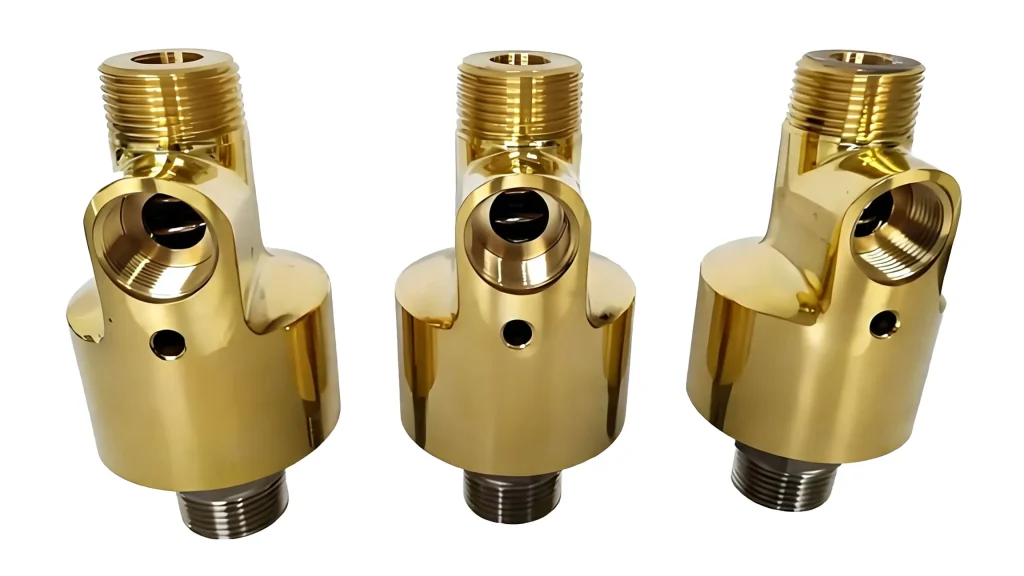
The H-type rotary joint is mainly designed for cooling systems and has the advantages of small size, light weight, and low friction resistance torque. Ball bearings ensure the coaxiality of the rotary tube, and the friction pair materials are available in various combinations according to different media environments, such as impregnated graphite, bronze, silicon carbide, tungsten carbide, etc., which can resist the influence of rust, scaling, and other impurities on the sealing surface. After finishing, the sealing surface looks like a mirror surface. More reliable sealing, longer service life, and wide application.
The HS-G type bidirectional circulation inner tube fixed rotary joint is a precision mechanical sealing device designed to transfer fluids (water, brine, air, hydraulic oil, or coolants) between a stationary supply pipe and a continuously rotating component — such as a roller, drum, or shaft — while simultaneously allowing return flow through a fixed internal tube.
Belonging to the H-series family of rotary joints, the HS-G model is engineered specifically for industrial cooling applications. It features a compact body, lightweight construction, low friction torque, and a balanced mechanical seal that dramatically extends service life even under high-speed operation.
Key characteristics that distinguish the HS-G from other rotary joint types:
- Bidirectional circulation: Fluid enters and exits simultaneously through a single joint — no need for two separate connections.
- Fixed inner tube: The internal guide tube remains stationary (does not rotate with the equipment), serving as the return-flow channel.
- Threaded or flanged connection: The hollow shaft connects to the roller via standard pipe threads or flanges, with left-hand or right-hand thread options.
Internal Structure and Components
The HS-G rotary joint consists of 13 key components, each serving a specific function in the sealing and flow path system:
| No. | Component | Function |
|---|---|---|
| 1 | Elbow | Inlet/outlet connection port |
| 2 | Locking nut | Secures the elbow to the housing |
| 3 | Spring | Provides seal face contact pressure; auto-compensates for wear |
| 4 | Housing (shell) | Outer body; features an observation hole for leak monitoring |
| 5 | Spring washer | Distributes spring force evenly |
| 6 | Flat gasket | Static sealing between mating surfaces |
| 7 | Auxiliary seal ring | Conical-surface secondary seal |
| 8 | Seal ring (main) | Core balanced-seal element — the heart of the joint |
| 9 | Shaft retaining ring | Positions and secures bearing on hollow shaft |
| 10 | Bearing (rolling) | Supports hollow shaft; reduces rotational torque |
| 11 | Hole retaining ring | Fixes bearing within the housing bore |
| 12 | Hollow shaft | Main rotating element; connects to roller via thread/flange |
| 13 | Inner tube (fixed) | Stationary return-flow channel inside the hollow shaft |
