Warning: Attempt to read property "post_title" on null in /www/wwwroot/cn.swiveles.com/wp-content/themes/twentytwentyone/single.php on line 177

Warning: Attempt to read property "post_title" on null in /www/wwwroot/cn.swiveles.com/wp-content/themes/twentytwentyone/single.php on line 219

Warning: Attempt to read property "post_title" on null in /www/wwwroot/cn.swiveles.com/wp-content/themes/twentytwentyone/single.php on line 219
Warning: Attempt to read property "post_title" on null in /www/wwwroot/cn.swiveles.com/wp-content/themes/twentytwentyone/single.php on line 219
Warning: Attempt to read property "post_title" on null in /www/wwwroot/cn.swiveles.com/wp-content/themes/twentytwentyone/single.php on line 219
Warning: Attempt to read property "post_title" on null in /www/wwwroot/cn.swiveles.com/wp-content/themes/twentytwentyone/single.php on line 219
Warning: Attempt to read property "post_title" on null in /www/wwwroot/cn.swiveles.com/wp-content/themes/twentytwentyone/single.php on line 219
High temperature swivel union
High temperature rotary joint is a dynamic sealing connection device designed for transporting fluid media from static pipelines to rotating equipment without leakage under high temperature conditions of 300 ℃ -450 ℃. The core of this device lies in high-temperature resistant sealing materials and thermal compensation structures.
- Operating Temperature400℃
- work pressure2.0MPa
- maximum speed100RPM
High temperature swivel union
High temperature swivel union, High temperature swivel unions, High temperature swivel joint, High temperature rotary joint, High temperature rotary joints, High temperature rotary union
High temperature rotary joint thermal oil rotary joint
Applicable conditions:
Applicable speed: ≤ 100RPM
Applicable temperature: ≤ 400 ℃
Applicable pressure: ≤ 2.0MPa
Applicable media: saturated steam, superheated steam, superheated water, hot oil, etc.
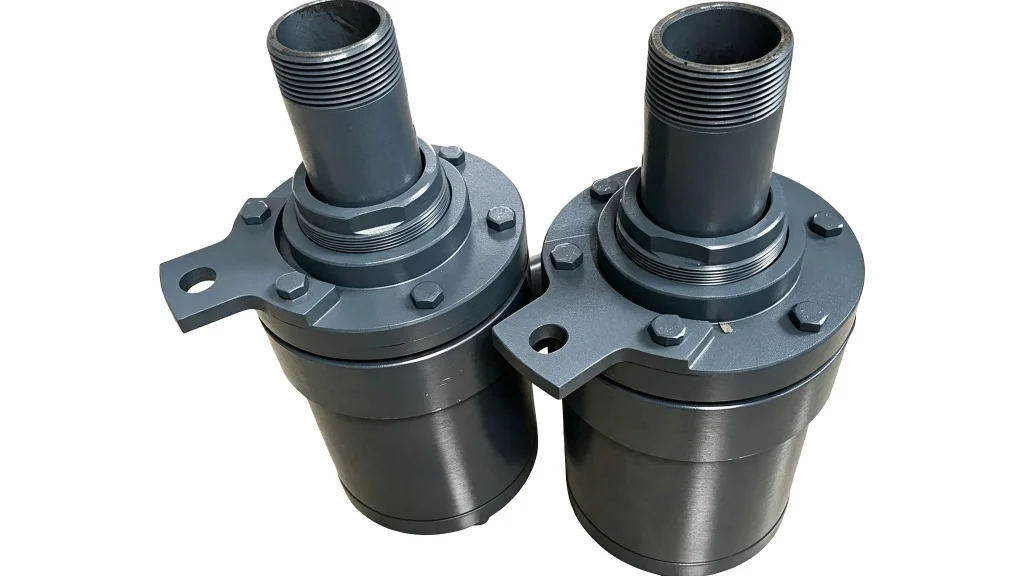
Product Material: Cast Iron
Usage environment: Equipment that uses steam or hot water, such as clinker rolling mills, internal mixers, hydraulic equipment, coating machinery, and other equipment that uses superheated oil.
Selection Guide:
Medium – Steam: Q-type should be selected for speeds below 100 revolutions per minute. (Pressure<2.0MPa)
Medium – Steam: D-type should be selected for speeds between 100-500 revolutions per minute. (Pressure<2.0MPa)
Medium – water, air: H-type should be selected for speeds below 1000 revolutions per minute. (Pressure<1.2MPa)
Medium – Thermal oil: Q-type should be selected for speeds below 100 revolutions per minute. (Pressure<2.5MPa, temperature<400 ° C)
Installation Guide:
Before installation, the impurities inside the roller (dryer) should be cleaned with compressed air, and there should be no iron filings or other impurities left
When connecting with threads, the rotary joint must be installed concentric with the roller until it is tightened.
When the medium is steam or thermal oil, the connection should be coated with high-temperature sealant before installation.
4. The hanging hole on the rotary joint should be hung separately and leave buffer space. It is not advisable to connect several joints in series.
5. After installation, run in the empty vehicle without medium for no less than 10 minutes to allow the rotating joint to function better.
Structural characteristics and working principle
Sealing form: Balanced end face seals or spherical seals are commonly used, which use springs or external pressure mechanisms to achieve automatic wear compensation and offset deformation caused by high temperatures.
Supporting structure: Common double oil-free bearings (graphite bearings) support, with automatic centering function, suitable for installation eccentricity; High speed/high temperature models are often equipped with external cooling systems for heat dissipation.
Core materials: Sealing rings often use antimony impregnated graphite and silicon carbide; The shaft head is made of heat-resistant alloy steel; The shell needs to be heat-resistant and designed with insulation to prevent heat transfer to the bearings.
Anti failure design: Some models include anti impurity intrusion structures, dual sealed backup, and external wear indicator devices to solve the problem of spring fatigue failure at high temperatures.
